
At SOFTECH, we encourage the research and product development from the earliest university years during the Codespring Mentoring Program and during the summer internship. Students, mentors and teachers often get to work together on valuable findings that worth to be published and presented in international professional environments too.
The Óbuda University from Budapest, Hungary, the Subotica Tech University, Serbia, the University North, Croatia, the Juraj Dobrila University of Pula, Croatia and the IEEE SMC Technical Committee on Computational Cybernetics in technical co-operation with John von Neumann Computer Society, Hungarian Fuzzy Association, Department of Mathematics and Informatics, Faculty of Sciences, University of Novi Sad, Serbia, Mihajlo Pupin Institute, Serbia and IEEE Serbia and Montenegro Section recently launched the call for papers for the IEEE 23rd International Symposium on Intelligent Systems and Informatics (SISY 2025). Held on September 25-27, 2025 in Subotica, Serbia, SISY conference welcomed all researchers that have met the quality review standards in 2025 to present the IEEE Papers.
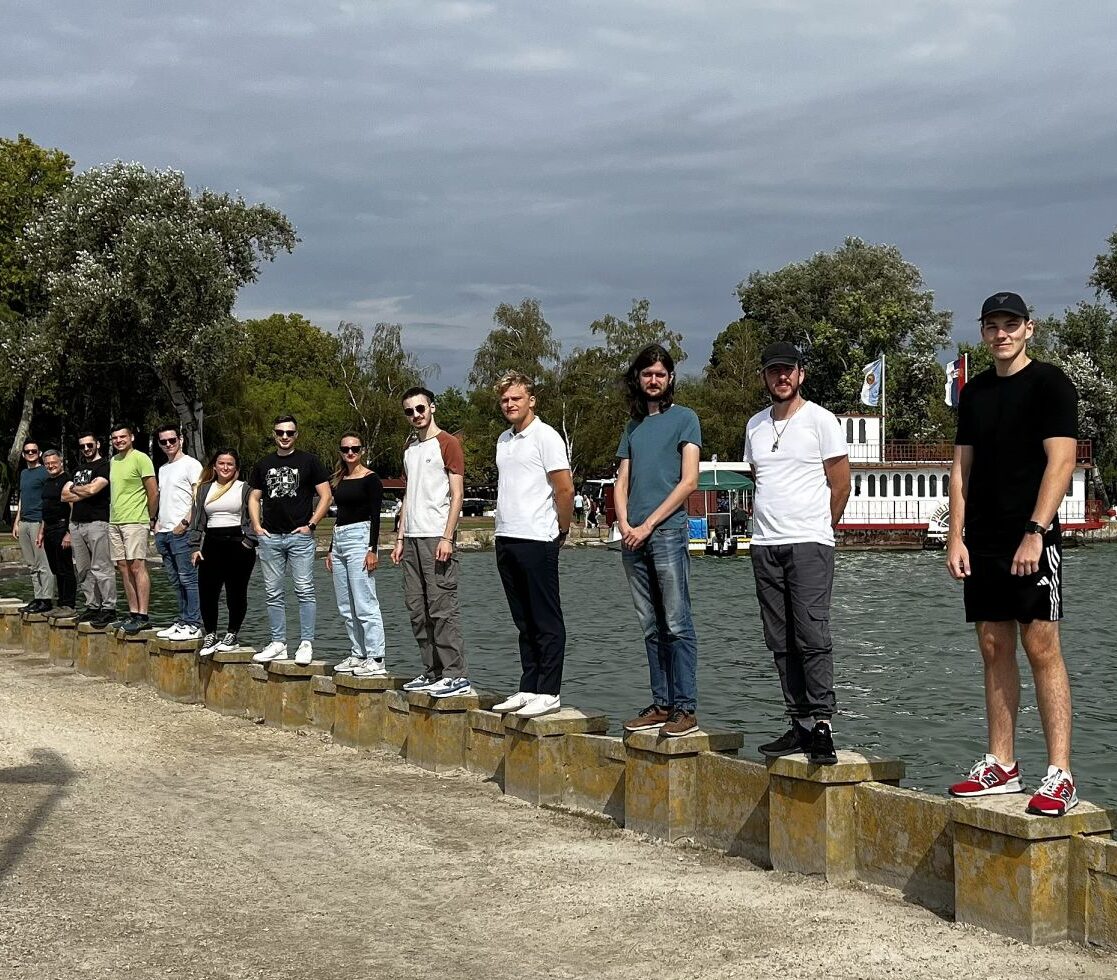
We are proud that four teams from our programme were invited to the SISY 2025 conference to present their research. The papers will bee soon available in the IEEE Xplore Digital Library and the selected papers will be published in a special issue of journal Acta Polytechnica Hungarica. Also you are welcome to find the article on the dedicared Codespring Mentoring Program’s page.
The Importance of Attending International Scientific Conferences
Programmers are known as geeks, who do not like to leave their comfort zone. In our experience this is an urban legend. We have been preparing students and junior colleagues to attend international scientific conference since more than a decade. The strategic position of our tech company was always to help our team reach a high level of proficiency in both research and documentation as well as in delivery and implementation. For that purpose, the opportunity of collaborating with our elite University in Cluj-Napoca in order to mentor students for their scientific papers, was always well received and tended to by our software development colleagues.
The main driver is that fact that our mentees are open to meet fellow programming students and researchers in order to discover innovative solutions in software development. We are especially fond of those students that are still connected to the academic environment and grab every opportunity to get in touch with researchers from related fields and to extend their scientific network.
In this context, the aim of SISY 2025 Symposium is, to offer researchers these opportunities and a fertile base to do the matchmaking between institutions in higher education and applied research.
Key Figures at SISY 2025
All in all, 120 researchers from 4 continents and 21 countries attended the 23rd IEEE International Symposium on Intelligent Systems and Informatics (SISY 2025). A total of 128 papers were submitted, out of which 97 papers were presented in Subotica, at the conference.
Fuzzy Theory and Other Hot Subjects in IT Research Today
The SISY conference returned to Subotica, after two years when it took place in Pula, Croatia. The opening ceremony, followed by a plenary session, chaired by Levente Kovács, IEEE Hungary Section Chairamn, that filled the iconic art nouveau City Hall.
Plenary Speakers, acknowledged researchers from Belgium, Canada, USA and Serbia opened the conference. The main topic was the fuzzy theory.
- Márta Takács, on the 60th anniversary of the birth of fuzzy theory depicted the challenges arose by practical applications preceding their mathematical and theoretical background. (abstract)
- Bernard de Baets’ keynote presentation explored pivotal milestones in fuzzy set theory, including fuzzy relational equations, computation with fuzzy quantities, and convolution lattices. (abstract)
- Robert Kozma introduced in his presentation the implementation of brain-inspired multi-sensory system designs combing the benefits of advanced AI/AGI and neuromorphic technologies, using embodied robotic platforms. (abstract)
- Ljiljana Trajković exposed some cons of data mining and machine learning: deep learning, broad learning, gradient boosted decision trees, and reservoir computing algorithms were used to develop models based on collected datasets that contain Internet worms, viruses, power outages, ransomware events, router misconfigurations, Internet Protocol hijacks, and infrastructure failures in times of conflict. (abstract)
International Symposium on Intelligent Systems and Informatics
The majority of the submitted works for SISY 2025 Conference focused on intelligent systems that can be successfully implemented in various areas of developing industries, all over the world. Papers, covering a large area, were presented at the conference in seven main sessions, as presented below.
Computational Intelligence (track chair: Amir Mosavi): Machine Learning, Genetic Algorithms, Neural Nets, Fuzzy Systems, Fuzzy and Neuro-Fuzzy Control, Knowledge Based Systems, Expert Systems
Intelligent Robotics (track chair: Enikő Nagy): Control, Flexible Arm Control, Perception and Recognition, Reasoning, Learning, Robotic Systems, Human-Robotic Interaction, Service Robots, Surgery Robots, Machine Vision.
(In this section our colleagues presented a paper on Automated Testing of Interaction-Requiring Devices with a Robotic Arm and Object Detection. Soon the full articles will be aviable on ieeexplore.org. Also you are welcome to find the article on the dedicared Codespring Mentoring Program’s page).
Intelligent Mechatronics (track chair: Radu-Emil Precup): Sensing and Sensor Data Fusion, Motion Control, Intelligent Actuators
Intelligent Manufacturing Systems (track chair: László Horváth): Flexible Manufacturing Systems, Production Planning and Scheduling, System Simulation, Rapid Prototyping, Concurrent Engineering, Virtual Reality
Informatics (track chairs: György Eigner and Gábor Kertész): The Web, Business & Digital Culture, Databases, Design & Graphics, Digital Audio, Video and Photography, Hardware, Home & Office, Networking & Sys Admin, Operating Systems, programming, Science & Math, Security Software Engineering, Healthcare Informatics, Teaching Informatics, Informatics in education process.
This section hosted three different papers authored by our colleagues:
- “VoteHub: Highly Customizable and Secured Voting System for Institutions Providing AI-Based Transcript Generation”,
- “Multimodal Retrieval-Augmented Generation for Context-Aware Chatbots”
- “Precise Indoor Positioning Using Ultra-Wideband”
(Soon the full articles will be aviable on the ieeexplore.org. Also you are welcome to find the article ont he dedicared Codespring Mentoring Program’s page) .
Applied Mathematics (track chair: Ivana Stajner-Papuga)
Special Session on PhD Student Research in Applied Informatics, Digitalization, Generation Research, Consumer Trends, 5G and Cybersecurity, Soft Computing-driven Intelligent Systems and Applications and Women in Engineering and Informatics.
Closing Thoughts
We are extremely proud that the students attending the Codespring Mentoring Program qualified for this prestigious scientific forum. Here we have to thank to our experienced colleagues, who proved to be dedicated mentors in coordinating the researches, putting together the whole projects, editing the international academic publications and training the presenters to shine at their best, during the 23rd SISY conference!