
Cluj-Napoca is emerging as Eastern Europe’s rapidly rising tech capital, with analysts, investors and media often referring to this city as „the New Berlin”. The tag relies not on the physical dimensions, Cluj being actually tiny compared to Berlin, but on the thriving startup ecosystem, extremely strong academic pool and visibly growing digital economy. Both cities are known for the academic and cultural activities, in their specific countries of origin – Romania and Germany, and both cities have thrived in the field of IT services. Each at their level attracts unique talent and is magnetic for start-up investors.
In the following paragraphs we will explore why the comparison between Cluj-Napoca and Berlin is relevant and how investors and growth managers can explore opportunities in both cities.
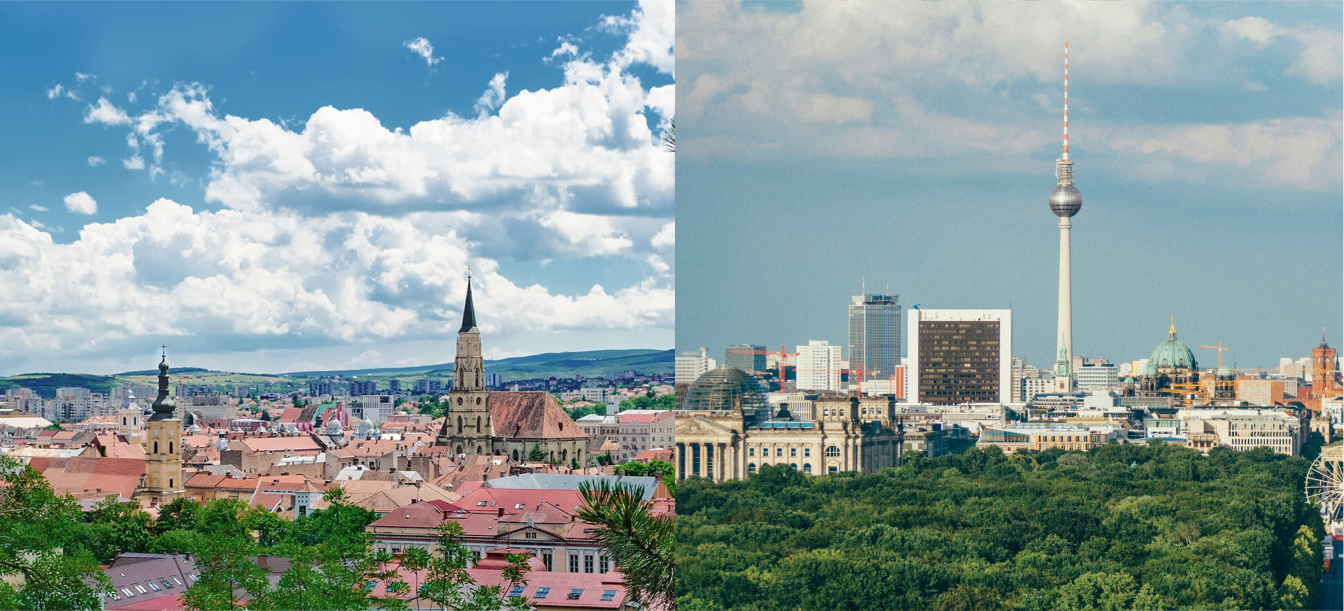
Photo credits: Cluj-Napoca image by Gabriel Rosca; Berlin image by Adam Vradenburg on unsplash.com
Key Facts About Cluj-Napoca and Berlin
In order to provide a quick look at the natural dimensions of each city and at the size of the tech ecosystem, we have put together a table of relevant facts: country ranking, inhabitants, cost of living difference, rent prices, number of international destinations connected to the city, number of universities and research institutes, type of communities.
In order to highlight the monitored dimension from our tech perspective, we have also counted the number of IT companies and IT employees, as stated in the official data. For a better understating of the ecosystem we have also researched the type and number of innovation oriented initiatives. This analysis is not intended to be exhaustive, it aims to provide a quick understanding of where the two cities are similar and where there is room for growth and original development.
| Indicator | Cluj-Napoca | Berlin | |
|---|---|---|---|
| City rank | 2nd | 1st | |
| Population * | 286598 residents | 3596999 residents | |
| Cost of living differences ** | – | + 54% higher than Cluj | |
| Rent Prices ** | – | + 116% higher than Cluj | |
| Connected Destinations*** | +50 destinations | +160 destinations | |
| IT companies |
| 12600 companies***** | |
| IT employees | 29000 persons**** | 145000 persons**** | |
| Universities * | +11 | +30 | |
| Research Institutes * | cca. 30 RIs | +57 major RIs | |
| Communities | Romanian, Hungarian, German, French | Cosmopolite city | |
| Innovation Oriented Initiatives | Selected Public initiatives Cluj Future of Work Urban Innovation Act OuCluj European Institute of Technology – Digital Innovation Hub UTCN Hub eDIH4Society TEDHIT Cluj Innovation Park Tetarom industrial Parks I,II,III Selected Private activities Transilvania IT Cluster Cluj IT Cluster ABC Incubator Transylvania Co-working Cluj Hub Xponential Transilvania Techsylvania Cluj Innovation Days The Developers Transylvania Digital Innovation Summit | Selected Public initiatives AI Hub Berlin AsiaBerlin Summit Berlin Startup Agenda 2022–2026 Berlin Startup Map Berlin Startup Scholarship Business Location Center Berlin Business Immigration Service Berlin Business Plan Wettbewerb Berlin-Brandenburg (BPW) de:hub Berlin DeepTech Berlin deGUT – German Startup Conference Gründen in Berlin IBB Förderfibel IBB Ventures Startup Unit Berlin Zukunftsorte Berlin Selected Public/Private partnerships Chemical Invention Factory Germanyʼs Official Deep Tech Hub | MotionLab.Berlin House of Finance and Tech Science & Startups Berlin STEAM Co-Working The Berlin Startup Factory Juni Selected Private activities Bayer CoLab Berlin Betahaus – Coworking space CIC Berlin – Coworking space Deep Tech Momentum – Marketplace and conferences Deltacampus – Coworking space Gitex Europe – Giant tech and startup event House of Industry Tech Impact Hub Berlin KI-Park Berlin Merantix AI Campus NLND – Innovation district RingBerlin – Makerspace Rise of AI – AI conference |
Data Sources:
* en.wikipedia.org / ** numbeo.com/cost-of-living / ***Cluj-Napoca and Berlin airports webpages / ****Romanian IT Market Study: Evolution and Perspectives / ***** dealroom.co
The table above reveals that while Berlin operates at a global scale, Cluj-Napoca appears as a concentrated and fast-growing regional tech hub showing powerful development potential.
Berlin Has Scale. Cluj Has Acceleration.
From the extracted data, we can observe that Cluj-Napoca benefits from an incredibly attractive cost-to-talent ratio, given the fact that Berlin has +54% higher cost of living and +116% higher rental prices, according to Numbeo statistics. Another interesting fact is that despite its smaller size, Cluj-Napoca has built a very dense IT ecosystem with over 2000 tech companies employing almost 30000 IT professionals, according to the latest Romanian IT Market Study: Evolution and Perspectives – issued by the Romanian Economic Monitor at UBB, in partnership with BERD and Transilvania IT. This positions Cluj as a very competitive nearshoring and innovation destination for any European company looking to contract high-quality engineering skills at affordable operational costs.
Berlin is undoubtedly stronger in terms of size, connectivity around the world, startup capital and institutional maturity. The incomparable number of research institutions, universities and innovation global initiatives consolidates Berlin’s role as one of Europe’s leading innovation capitals.
Nevertheless, the comparative table shows that Cluj-Napoca is intentionally developing the structural ingredients for future established tech ecosystems. It attracts and cares for international communities, organizes innovation-oriented public initiatives, industrial parks, start-up clusters and digital programs. All these initiatives express a moment of transition from a mere outsourcing centre to a diverse innovative and product development ecosystem.
Berlin Pushes New Frontiers. Cluj Is Still A Growth Lab.
Depending from the angle of analysis, each city has its advantages and disadvantages. However, the differences make room for different type of investors, deals and research initiatives.
Taking into consideration that, according to dealroom.co, Berlin counts 57 unicorns and/or thoroughbreds, spears in the sector of enterprise Software, Climate tech and Fintech, ranks 4th in Europe for VC investment, 2nd for number of rounds and #3 in Europe for Frontier AI researchers, the German city is one of the heavyweight innovation capitals in the world.
Cluj-Napoca is none of the above, but is rising quickly in the ranks. It is a highly competitive, fast-moving and dynamic tech market. The local tech entrepreneurs are used to major market shifts and volatility, which makes them fearless market players, trustable business partners and agile investors.
Want to Learn More About These Cities?
If this quick comparison between the two tech ecosystems in Cluj-Napoca and Berlin made you curious, we recommend to plan a business visit in each. There are multiple opportunities in Berlin and several nice occasions in Cluj-Napoca.
Since, our SOFTECH team is based in Cluj-Napoca, we will be glad to meet you online and in person. Feel free to write us on contact@softech.ro
by: Diana Roșca